Demo
See what a run actually produces
A walk through one prompt turning into a live business website — researched, written, shipped to your Git, and then maintained on a schedule. This is the whole loop, not the first ten seconds of it.
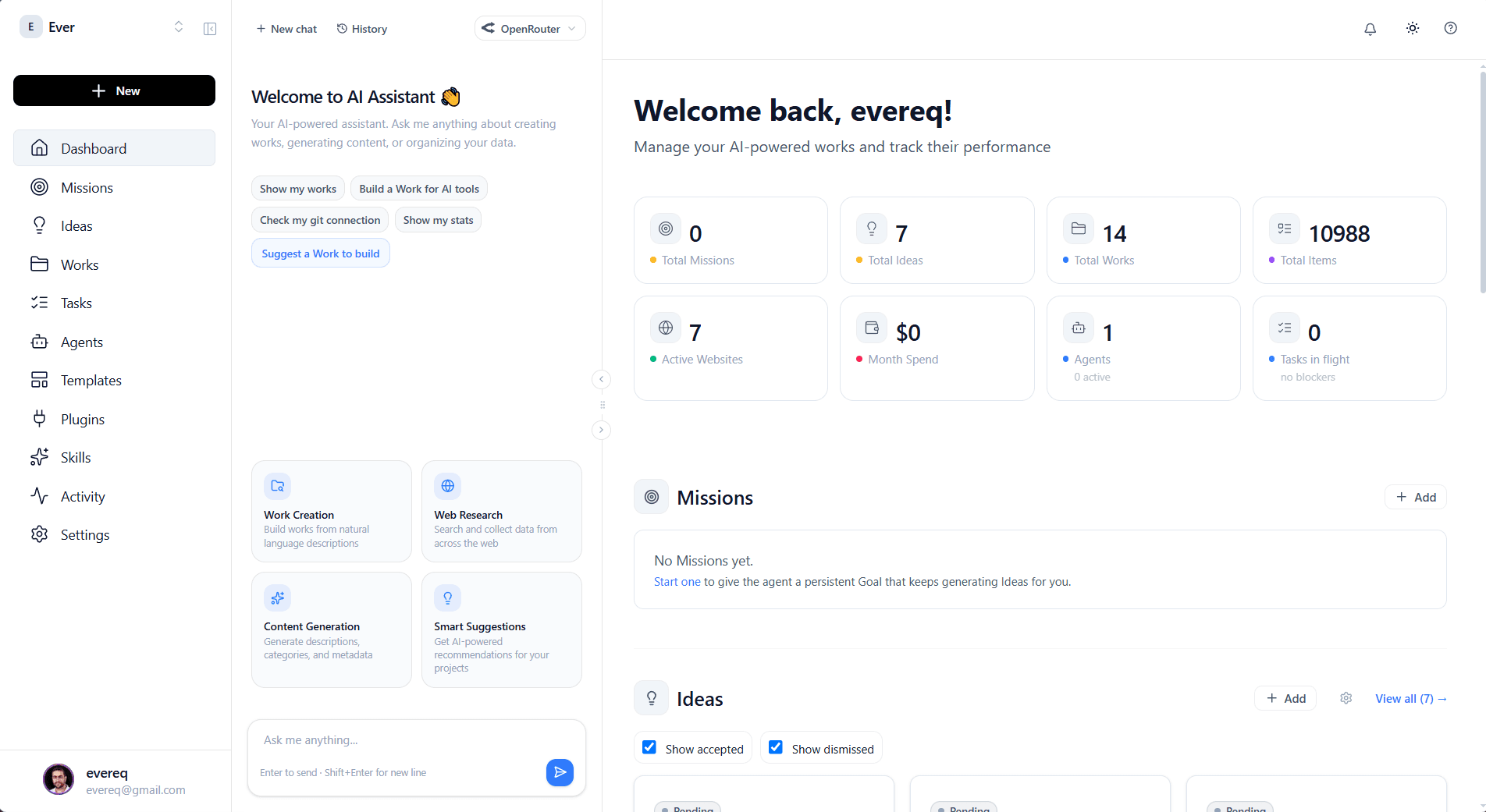
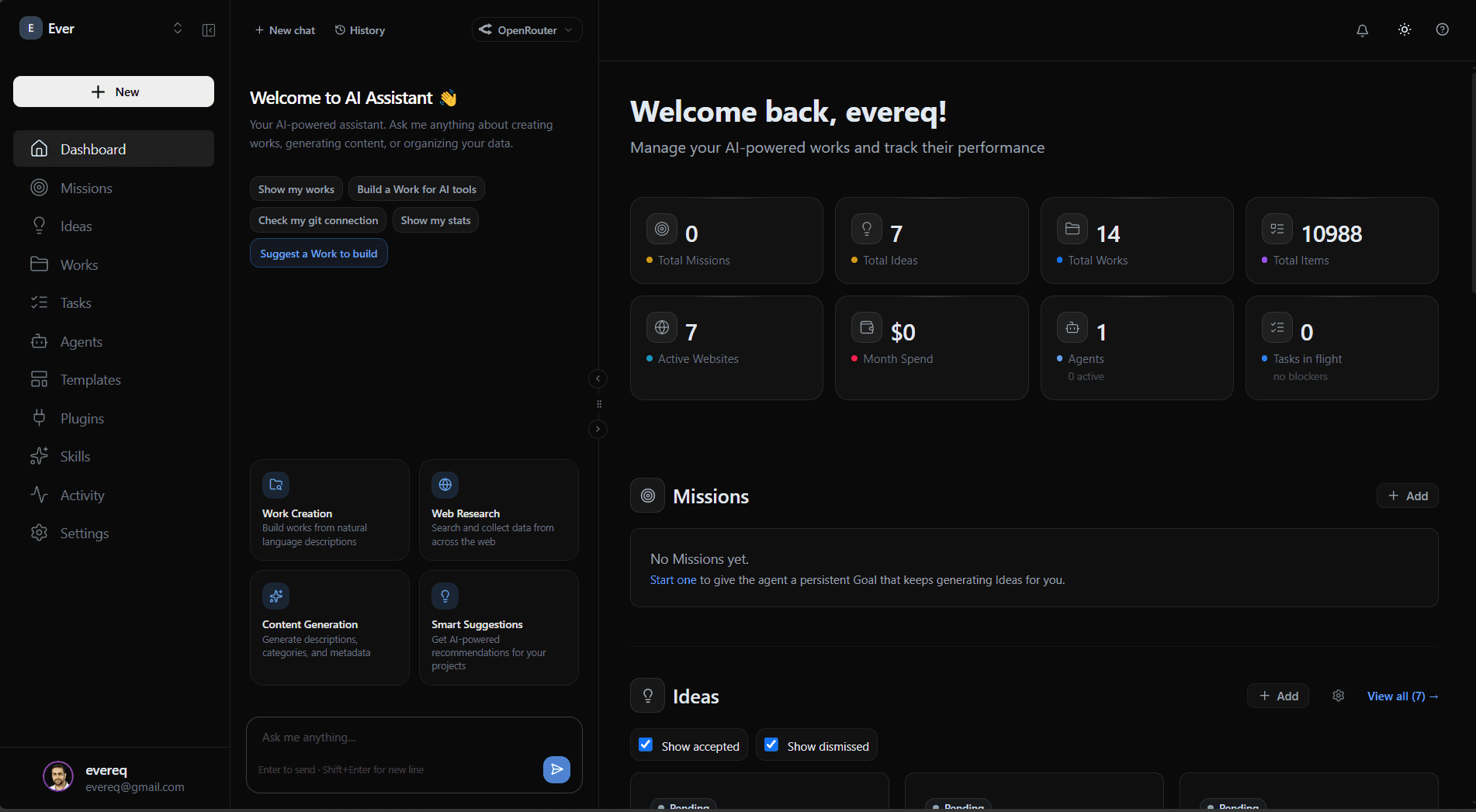
Three ways a run starts
Everything in Ever Works is a Work — a content hub backed by your own repositories. You can start one from a sentence, from a form, or from a repository you already have.
Create with AI
Describe the Work in natural language. The runtime names it, writes the description, builds the category structure, finds the items, and sets up the GitHub repository.
Create manually
Set the name, slug, description, README header and footer yourself, and pick the organization the repositories land under. Full control over every setting.
Import existing
Point it at a GitHub repository — a data repo with .works/works.yml, or a plain Awesome List README. Copy it, link it directly, or use it as a research seed to expand from.
What happens in a run
One prompt goes in. Five things come out of it, and the last one never really finishes. Each phase below lists the pipeline stages you watch tick past in the app — with live logs, if you want them.
- 1
You describe it
A prompt in plain language is the entire input. Optionally add company details, seed categories, and target keywords — everything else has a sensible default.
- Processing your prompt
- Detecting domain type
- 2
It researches the subject
It drafts its own search queries, runs them, pulls the pages back, and throws out anything below your relevance threshold before a single item is written.
- Creating search queries
- Searching the web
- Retrieving content
- Filtering relevant content
- 3
It writes the content
Items are processed out of the retrieved content, deduplicated, sorted into categories and tags, and their sources are checked for accuracy — then written out as markdown.
- Processing items from content
- Removing duplicates
- Categories and tags
- Validating sources
- 4
It ships the code
A website repository is created from a production template, the content is committed to your Git, and it deploys to your provider. Deployment usually takes one to three minutes.
- Generating markdown content
- Website repository created
- Deploy + custom domains
- 5
It keeps going
Set a cadence and it re-runs on its own — refreshing content, re-checking every source URL, and opening pull requests instead of committing directly if you prefer review.
- Scheduled runs
- Source health checks
- Community PR processing
What you get to steer
The runtime does the work, but nothing about it is opaque. Every Work opens into these, and you can take the wheel at any point.
Items
Browse, search, and edit every item. Add one from a URL and it retrieves the details for you. Categories, tags, and collections each get their own tab.
Generator
Re-run generation with a new prompt, override the AI model, cap search queries and pages, and set the relevance threshold. Custom prompts per pipeline step live here too.
Schedule
Hourly through monthly cadences, a failure limit that auto-pauses after too many bad runs, and a toggle to raise pull requests rather than commit straight to main.
Comparisons
Generate A-vs-B comparison pages between any two items — summary, scored dimensions, verdict, full article, and an optional deep-dive extended analysis.
History
Every run, with items added and updated, duration, tokens used, cost, and expandable step logs. Nothing about a generation is hidden from you.
Deploy
Pick a deploy provider, choose the website template, configure the site before shipping, and attach custom domains with the DNS records shown inline.
Plugins
Choose which provider fills each capability for this Work — AI, search, screenshots, content processing — overriding your account defaults when you need to.
Members
Invite collaborators as Owner, Manager, Editor, or Viewer. Editors can run generations; Viewers get read-only access; only Owners can delete.
Your keys, your models, your infrastructure
Capabilities are filled by plugins, and you choose the provider behind each one — for your whole account or per Work. Bring your own key and the runtime uses it directly.
- AI provider
- Claude, Codex, Gemini, SIM AI and more, each set up through a guided wizard that verifies the connection before it finishes. Override the model per run.
- Search
- The provider that finds content on the web. Cap the query count, results per query, and pages processed to control both quality and spend.
- Screenshots
- Capture a screenshot or product image for every item automatically during generation, or on demand for a single item later.
- Content processing
- The provider that turns a fetched page into structured content, with a relevance threshold you set yourself.
- Git provider
- GitHub, connected per account or through the Ever Works GitHub App, with organization repositories supported.
- Deployment
- Deploy to your own provider account and attach custom domains. The DNS records to add are shown right in the app.
Content and code together
Most AI builders generate a shell and expect you to fill it. Here the research and the writing are part of the same run as the build — and the site config, header, homepage, and footer are yours to set.
It runs after launch
The interesting part starts once the site is live: scheduled agents refresh content, re-validate every source URL, and process community pull requests the way an in-house team would.
Git-native, open source
Data, markdown, and website each land in repositories you own, with your own committer identity on the commits. The runtime that produced them is open source — nothing depends on trusting a black box.
The fastest demo is your own idea
Describe the site you actually want. Watching it get researched, written, and shipped tells you more than any tour will.